|
|
|
|
|
|
|
|
Quick Site Links
>
|
Archived Resource Focus articles Our Resource Focus articles are a series written by some of the top art professionals in charge of visual art non-profits in the San Diego region. These organization have survived and even thrived during the COVID Pandemic. We asked them to report on the their current position and their future visions for thier organizations. Watch this space and Join our mailing list. for our eblast announcements of new articles added. Art Resource Focus 2024
SDVAN New Grant by Patricia Frischer
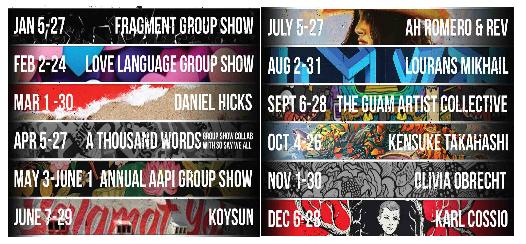
In the last of our series called Art Resource Focus (for now), we are looking more closely at ourselves at San Diego Visual Arts Network (SDVAN). These foci have mainly asked the organization what plans they have for the future especially after the pandemic recedes. The most special event for this year is the County Supervisors Neighborhood Reinvestment Program grant of $6000 we received from District 3 . This is a one-time expense to create a platform to enable small non-profit organization to send bulk emails at an affordable rate. The price of sending bulk emails has been rising (examples: Constant Contact and MailChimp) and by creating our own not-for-profit platform we can keep cost down, not only for SDVAN, but for a few other small non-profits in the arts. The platform allows articles, photos and events to be created and inserted in a professional presentation. New contacts can be gathered directly from org websites with privacy enhanced features and individualized contact list can be created. Social media sharing is easy and fast for articles and events. This project is made possible by the County Supervisor grant as well as receiving $3500 in free software services from Microsoft Azure which we can renew every year. In addition, in the first year we have sourced $1000 free software services from Amazon Web Services (AWS) for additional testing expenses. We have been working on this for 2 years and you have all seen the results of this in our emails that are sent out twice a month and maintain the professional format, but cut the cost of bulk emails for us considerably. During COVID, SDVAN worked on virtual events and even made a special archive on the website. We had to cut our programming like everyone else, but we managed to keep the SD Art Prize alive and well. In fact, we improved it by recruiting national and international selectors to choose the final 4 recipients. This meant that all the nominated local artist were seen by a wider range of art professional. Watch for our 18 th year in the fall, for the first time in Balboa Park at the San Diego History Centeragain curated by Lara Bullock We have increased our advocacy efforts and now list more than 70 advocacy articles either in our A+Art Blog or our Picked RAW Peeled blogs. We worked with the North County Arts Network to produce their Networking event on June 6. It will feature a talk by Tracy Hudak from CA for the Arts on Affordable Housing for Artist near Cultural Arts Districts. The funding for the arts statewide could be slashed by 59% and we have an article this month detailing the California Arts Council reaction to those cut. If you want to know more about our advocacy efforts, you can attend a LIFE meeting at Mira Costa College in Oceanside on June 14 at 1 pm where I will give a State of the Arts lecture. Public Art, Civic Art, Arts Funding, and Cultural District will all be included as well as a selection of summer art events not to miss. Becoming an Woman of Impact for Arts and Culture in 2024 by Tasha Boerner made me realize how important the work of arts advocacy really is. We really have no idea what changes the future will bring. We continue to believe that the San Diego Visual Arts Network is a powerful force that connects art to people and people to art. We believe that artists serve as interpreters, explorers, and creators of the great unknown. We believe every life is an artwork, a mess, a makeover, and magnificent. We believe, most of all, that Art Builds Community. Thumbprint Gallery Preview 2024 by Paul Ecdao Similar to last year, we are completely booked for the year at the Thumprint gallery in La Jolla with themed and un-themed Bar Basic pop up shows sprinkled in between. In January, we expanded our gallery hours to include Sundays, noon-4p and hopefully work our way back to being open Fridays again, however we still hold our opening receptions on 1st Fridays to coincide with the surrounding La Jolla Art Walk, involving 20+ nearby galleries. The gallery shows remain a blend of group, solo, and duo exhibitions, with a couple of collaborative shows featuring So Say We All, a local non-profit literary and performing arts organization and TGAC (The Guam Artist Collective) with their sophomore exhibition following their inaugural show last year with us. The solo exhibitions are a mix of new and familiar faces, mostly local but with new artists like Kensuke Takahashi from Yokohama, Japan. We first noticed his amazing mural work inside Tora Tora Sushi in Mira Mesa, decided to reach out, and surprisingly heard back immediately when we offered him a solo show. He is scheduled to install a mural at another local venue around the time of his show so be on the lookout for our announcements! In March, we are excited for "Process/Material", the 2nd solo exhibition by Daniel Hicks in our space, who we first came across when he participated in our Bar Basic shows. He continues to refine and experiment with his minimal abstract work, building on what we consider a substantial consistent body of work. In May, we will present our 2nd Annual AAPI Group Show which will be a traveling exhibition once again, having it as a pop up showcase at the 2024 San Diego County Fair Asian and Pacific Islander Festival Day in June. Lourans Mikhail will be joining us again this August for a follow-up to his 2020 solo exhibition, while Olivia Obrecht and Karl Cossio (half of Kymera Studio) have their first solo shows in our space later in November and December, respectively. We have been displaying inventory on a wall at Distinction Gallery and have plans to divide up our wall to rotate featured artists later this year. Because of our limited space and gallery hours in La Jolla, it's a great opportunity for anyone to see work during their business hours and opening receptions. Our shows at Bar Basic from 6p-9p, feature un-themed group exhibition by local artists. We will have affordable prints available and the event is always free and open to the public. If you decide to visit, we highly recommend their bacon and potato pizza. :o) Institute of Contemporary Art by Jordan Karney Chaim
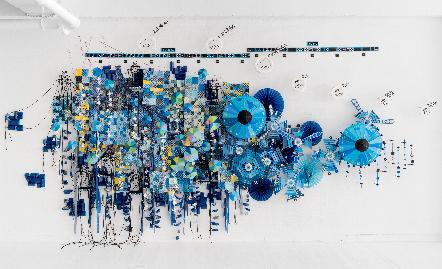
For its 2024 season, ICA San Diego celebrates the region as a hub of boundary-pushing innovation in both art and the life sciences. Since the establishment of several pioneering research institutes in the mid-20 th-century, including the Salk Institute and University of California San Diego (UCSD), the region has continued to attract creative thinkers drawn to its particular blend of opportunity, entrepreneurial spirit, and unbeatable weather. Interface, the collective title for the four exhibitions that will anchor our year of programming, invites audiences to consider how art can mediate, translate, and expand the relationship between humans and the science of everyday life. In addition to ICA San Diego’s annual NextGen exhibition celebrating local emerging talent, the Interface season will consist of six exhibitions spread over ICA’s two campuses in Balboa Park and Encinitas. As always, admission to the museum is free and ICA hosts free monthly public C You Saturday! events with special access to artist talks, exhibition tours, food and music. Rather than searching for points of intersection between art and the life sciences, the exhibitions that define Interface offer an opportunity for continuous exchange. The Winter/Spring exhibitions by Turkish-born, San-Diego based artist Dr.Pinar Yoldas (ICA Central)and the Danish art collective SUPERFLEX (ICA North) engage in conversations about where the human ends and the non-human begins. The artists’ various projects consider how we might build the future in collaboration with other species and imagine a world beyond the Anthropocene. The second half of the season offers solo exhibitions by Rafael Lozano-Hemmer, Nathalie Miebach, Manuel Alejandro Rodríguez-Delgado, and Melissa Walter. For her presentation at ICA North, San Diego-based Walter will interpret the evolution of DNA-identification technology and its influence on the criminal justice system through works on paper and experimental animation. Walter’s exhibition will be accompanied by Rodríguez-Delgado’s first solo museum presentation in the continental US. Through his experimental sculpture, Rodríguez-Delgado assesses the techno-optimism of 1980s America by creating mobile survival systems to navigate the future challenges facing our planet. In Balboa Park, the ICA Central mezzanine will be the site of celebrated Mexican-Canadian artist Lozano-Hemmer’s interactive installation, Remote Pulse (2019), which will connect museum visitors to their counterparts at the Centro Cultural Tijuana via the sensation of a virtual pulse. An exhibition by Boston-based Miebach will occupy the gallery space and will include woven sculptures and wall installations based on scientific data. Using meteorological, observational, and anecdotal information, Miebach has devised her own visual language to foreground the human relationship to data in her meticulously researched practice.
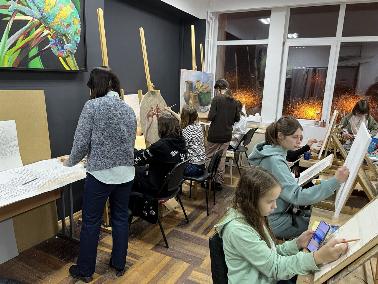
The local Synergy Arts Foundation (SAF), is currently assisting Cadium Art Center in Kharkov, Ukraine. Since the children of Kharkov are not able to attend public school, Daria Kilochko, the Founder of the school, has created this center as a safe and creative place for 55-80 children. Their fathers are separated from their families and since the war began, these children have lived in bomb shelters and subways. Some of them were under occupation and miraculously survived. Kharkov continues to be bombed. Air raid alerts can happen as often as 10 times per day. Under these extreme circumstances Daria has created an amazing arts program for these children. This project aligns with the SAF mission - to support and nurture artists and arts organizations of all disciplines by offering emergency financial grants in times of crisis as well as viable opportunities and resources. We pioneer programs in arts education for under-served, at-risk populations, including arts for healing, community arts, and specific international and national art projects recovering from disasters. Internationally, we have worked with Aids orphans in Zimbabwe, several orphanages in Baja Norte, Mexico, We raised funds for artists impacted by the earthquakes in Haiti and Peru, the hurricanes in New Orleans and Puerto Rico and now in Ukraine. Through our Arts for Healing projects, we have provided brain-injured patients from Scripps Encinitas with a safe and creative place to express themselves and create comradery. We also offer virtual classes to people in the community recovering from brain injuries, cancer, Parkinsons. We have executed projects with Lifeline, Oceanside, Wives of Warriors (Vet wives), and foster children based at San Pasqual Academy, Escondido, battered women at Vista Hill, San Diego. Founded in 2003, Synergy is a 501c3 organization entirely supported by volunteers, all artists who care about our fellow artists and arts organizations. The grants are open to professional artists who have resided in San Diego for a minimum of two years. Each application is evaluated by the board and, if approved, funds are usually received by the applicant within a week. Arts organizations are eligible as well. We often receive proposals for interesting arts projects to which we may choose to support.
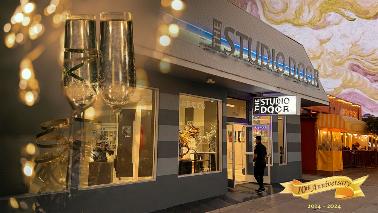
As The Studio Door prepares to mark a significant milestone – its 10th anniversary – the gallery stands as a testament to the transformative power of art and the unwavering dedication of its founder, Patric Stillman. Since its establishment in 2014, The Studio Door has not merely been a space for art; it has become a dynamic force shaping the narrative of San Diego's art scene. Guided by a commitment to diversity, inclusion, and the practical support of artists, The Studio Door has emerged as a beacon of artistic resilience, providing a platform for mid-career and professional artists to flourish. In a world where the term "starving artist" is often synonymous with the pursuit of creative passions, The Studio Door has defied convention. Beyond being a gallery, it has pioneered an artist-run business model, showcasing the tangible possibilities of sustainable art careers. As the creative community expands, The Studio Door is not just creating art; it is crafting a legacy unparalleled in the region, embodying the belief that art is a powerful vehicle for creating the world we want to live in. The Studio Door is a vital visual arts gallery nestled in San Diego, distinguished by its 17 working studios that provide artists with practical spaces to create and showcase their work. The gallery hosts monthly community events, both within its premises and in the vibrant Mural Alley, fostering a dynamic connection between artists and the public. Renowned for its signature annual events, The Studio Door presents The Crow Show and the LGBTQ+ PROUD+ exhibition, offering a platform for artists to showcase their diverse creative voices. Beyond the gallery's storefront, owner Patric Stillman is the driving force behind a continuous surge of creative commerce, professional development, and marketing endeavors aimed at amplifying the visibility and success of local artists. This commitment to supporting artists extends beyond the traditional gallery setting, making The Studio Door a hub of not just visual arts but also a thriving community of artistic commerce and growth. THE YEAR AHEAD - Looking forward, 2024 appears to be a banner year with expanded programs and innovative collaborations. As of the date of this publication, Calls for The Studio Door’s national shows are opening. Dates and detailed information for additional Exhibitions, Programs and other opportunities will drop over the next few weeks on The Studio Door website Gallery Exhibitions - Art sales remain central to The Studio Door’s operations, offering mid-career and professional artists a vital space to showcase possibilities for sustainable art careers. Notable exhibitions include the monthly curated gallery exhibits, the 10th Annual The Crow Show, 7th Annual LGBTQ+ PROUD+ and 2nd Annual ART+ LBGT History Month. The gallery has already confirmed collaborations with The Bureau of Queer Art (Mexico City, Mexico), La Onda Arte Latino (Border Artists), Lambda San Diego Archives, historian Mike Balaban and artist Kevin Winger.
Also, expect eyes to be raised as the gallery holds its first body and sex positive museum-styled fine art Erotic Art Exhibition to arrive next summer. Artist Professional Development - Recognizing that creative vision needs practical support, The Studio Door continues its commitment with 17 artists' studios, 6 rental exhibition spaces, and new initiatives like the Transformation Artist Lab workshop with RD Riccoboni and Patric Stillman. Newly expanded Artist Professional Development mentoring, including gallery exposure, ensures artists thrive in a competitive and evolving creative landscape. Community Collaborations - Deeply connected to its Hillcrest neighborhood, The Studio Door will continue to actively engage in community development, participating in Hillcrest First Thursdays in Mural Alley and reporting on San Diego Arts for The WORD San Diego. Programs - In the ever-changing landscape of the art community, adaptation is key. Art spaces must transcend traditional programming to remain relevant. Recognizing the imperative for innovation, The Studio Door actively promotes education, provides enjoyable experiences, recognizes artists, and champions experimentation. Three exciting new programs are set to enhance the community, empower artists, and ensure the continuous growth of the arts in the region: the monthly Painting with the Masters workshop series featuring Patrick N Brown, Joan Hansen, RD Riccoboni, and Andre Rushing; Art Shack, a weekly LGBTQ+ artist hangout; and the Stillman Art Prize, a prestigious award celebrating the achievements of San Diego queer artists. Exclusives - Marking a decade of insights, The Studio Door will launch two exclusive web series on LinkedIn and online for Artists and Patrons, along with a commemorative book, sharing knowledge and celebrating its journey as an artist-run space. The Studio Door's 10th anniversary heralds not just a milestone but a continuation of its transformative impact on the local art scene, embodying a commitment to artists, community, and the enduring power of the arts. Archived Resource Focus articles 2006 - 2015 |